Ally: Bank, Auto & Invest
- 4.4
- Rating
- 1.00M
- Installs
- Free
- Price

 Analysis by App-foxy
I came away from Ally: Bank, Auto & Invest with a fairly clear impression: it is most useful when you want one finance app to sit at the center of your everyday money routine, rather than a specialist tool for only one task. Ally Financial has built it for banking, auto-related finance, and investing in the same general experience, and that combination is its main appeal. I found it easier to understand my financial activity when I did not have to jump between completely unrelated services.
That convenience does not make it perfect. A broad finance app inevitably asks you to accept some compromises in depth, organization, or personal preference. Still, I think it is a sensible choice for people who already use Ally services or who want a single place to check their financial life. It is free to download, aimed at everyone, and its large user base suggests that the approach works for many people. The important question is whether its all-in-one design matches the way you manage money.
One app for banking, auto finance, and investing
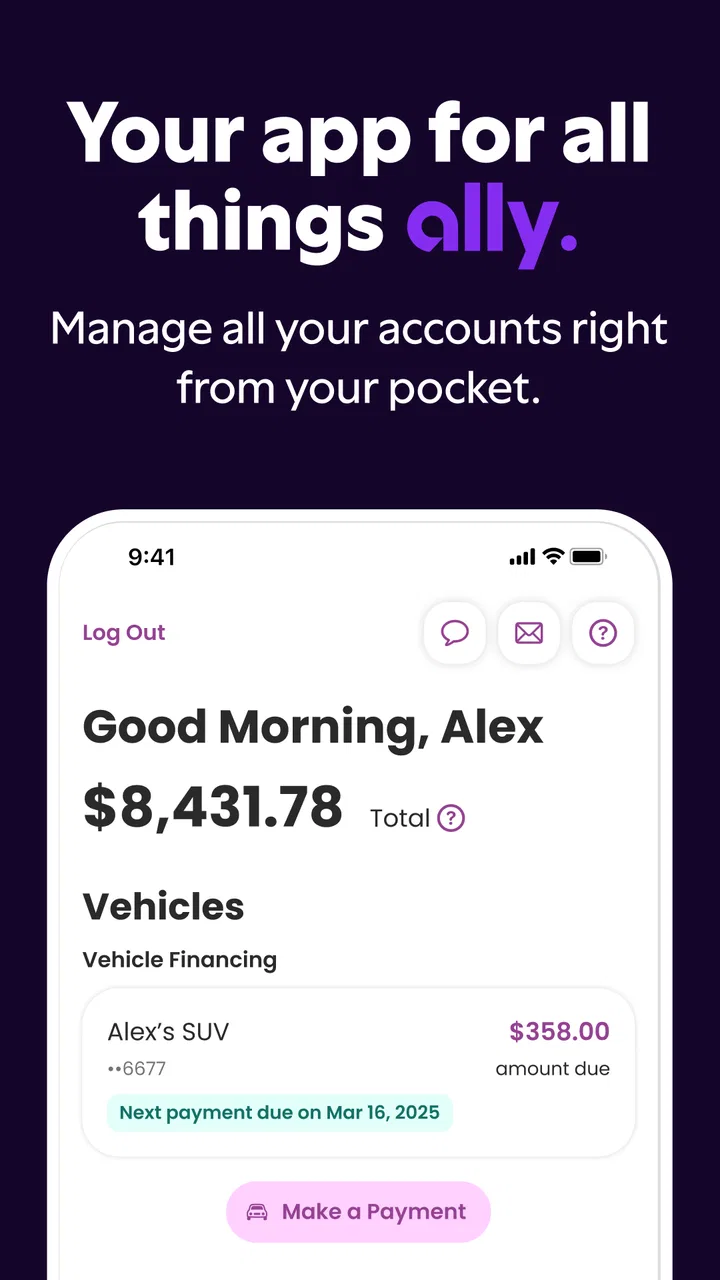
The clearest strength is the range of financial jobs gathered into one app. Instead of treating checking, vehicle finance, and investing as separate destinations, Ally presents them as parts of the same relationship with your money. That matters in ordinary situations. If I am checking whether a payment has cleared, thinking about a car balance, and then reviewing investments, I would rather begin in one familiar app than remember several different logins and layouts.
You May Also Like

 Blood Strike: 2.5 Anniversary
Blood Strike’s Loadouts Turn Every Drop Into a Tactical Gamble
A close look at Blood Strike’s custom loadouts: how fast access to signature weapons reshapes its battle royale rhythm, rewards preparation, and narrows the gap between fights.

 Pandora - Music & Podcasts
Pandora’s Music Is Easy to Start, but Harder to Recover
Pandora’s strength is its low-effort path from a seed to a station. Its weak spot is how much confidence it asks you to place in connection, setup, and quiet recovery.

 8 Ball Pool
 Is Built on Rivalries, Rematches, and Routine
A close look at the rivalries, rematches, shared routines, and unanswered safety questions that turn a quick pool match into a persistent mobile community.

 Samsung Music
’s Quiet Strength Is Playing What You Already Own
Its reach comes less from spectacle than from dependable access to a personal library. That simplicity is both the app’s strongest retention engine and its ceiling.

 AccuWeather: Weather Radar
AccuWeather Review: A Quick, Clear Forecast for Everyday Decisions
For everyday plans, the best forecast is the one you can understand quickly. AccuWeather makes rain timing, radar, and local conditions easy to act on, with a few trade-offs.

 Hill Climb Racing
Why Hill Climb Racing Still Turns Crashes Into One More Run
A tiny car, a bumpy hill and one more upgrade: Hill Climb Racing keeps resurfacing because its simple chaos makes every near-miss feel personal.
More From Our News Desk



The app comes from Ally Financial, a developer whose name is closely associated with financial services rather than general-purpose budgeting software. That distinction is useful when deciding what to expect. I see this as a service-management app first, not a neutral money journal that pulls every account from every institution into one carefully designed household budget. Its strongest experience is likely to come when Ally is already part of your financial setup.
In practical use, the value is less about a flashy feature and more about reducing small points of friction. A finance app becomes part of a routine when opening it feels quicker than finding a browser bookmark, remembering which service handles a particular account, or searching through old messages. For a user who wants a direct view of Ally-related activity, that focused access is more meaningful than a long list of optional tools.
I also appreciate that the app is not presented as a niche product for a narrow age group. Its content rating is Everyone, which fits the straightforward purpose of managing personal finances. That does not mean every financial decision is simple, of course. It means the app itself is positioned as a general finance tool rather than something built only for professional investors or advanced automotive users.
Where the combined approach helps most
A realistic example is a monthly money check-in. I might open the app after receiving income, review recent banking activity, look at an upcoming auto payment, and then glance at investment progress before deciding how much flexibility I have for the rest of the month. The benefit is not that the app makes the decision for me. The benefit is that it gives me a more connected starting point.
That connected view can also make conversations about money less scattered. If a household is trying to understand how a vehicle commitment fits alongside saving and investing, having related Ally services nearby can make the review feel more manageable. I would still want a separate budgeting method for detailed category planning, but the app can serve as the place where I confirm the underlying financial activity before updating that budget.
Another useful habit is to check the app before making a large discretionary purchase. I can review the current state of my accounts and consider whether an auto obligation or investment contribution changes the decision. This is a small workflow, but it is better than relying on memory. Financial apps are most helpful when they support a repeatable habit, and this one has a natural role in that kind of quick review.
One less obvious trade-off is that convenience can encourage passive checking. Seeing several financial areas together may feel reassuring, but a single screen does not automatically explain whether a portfolio is suitable, whether a payment fits a long-term plan, or whether spending is drifting upward. I would use the app as a source of current information and account access, then make bigger decisions with more context.
What the app does not replace
I would not choose this as my only tool if my main goal were detailed envelope budgeting, extensive spending categorization, or a complete picture across numerous outside institutions. A dedicated budgeting app may be better for assigning every dollar, tracking household categories, and comparing spending over time. A specialist investment platform may also be preferable for someone who wants a research-heavy investing workspace.
That is not necessarily a failure. An all-in-one finance app has to balance different types of users, while a focused alternative can spend its entire design budget on one problem. The right comparison is therefore not “does Ally do everything better?” It is “does keeping these Ally-related tasks together save me enough effort to justify using a broader, less specialized experience?” For many existing Ally customers, I think the answer can be yes.
There is also a mental-load issue. Banking information, auto finance, and investing do not carry the same urgency or risk. A banking balance may require immediate attention, while an investment view is often more useful as part of a longer review. When different topics live close together, I need to slow down and read the context instead of reacting to whichever number catches my eye first.
How I would use it day to day
My preferred routine would be short and deliberate. I would open the app for a specific reason, such as checking a transaction, reviewing an auto account, or looking at investments, rather than repeatedly refreshing it without a question in mind. After checking, I would record any action that needs follow-up elsewhere. This keeps the app as a practical control panel instead of turning it into a source of financial anxiety.
For a household, I would agree on what the app is responsible for and what belongs in a separate budget or planning document. For example, the app could be used to verify balances and activity, while a shared sheet handles upcoming bills and savings targets. That division prevents the common mistake of assuming that account access and full financial planning are the same thing.
I would also review account labels and transaction details carefully rather than treating a quick glance as proof that everything is correct. Financial information deserves a slower check, especially when several account types are shown in the same place. The app can make access easier, but it cannot remove the need to notice unusual activity or question an unexpected figure.
For investing, I would use the app to stay aware of my position and maintain a consistent review schedule. I would avoid making an impulsive change simply because a short-term movement looks uncomfortable. The presence of investing inside a banking app is convenient, but convenience should not turn every routine login into a trading decision.
Performance, familiarity, and trust
The app has been available since April 26, 2012, so it is not a new experiment in mobile finance. Its current version is 26.1.1, and it supports operating system version 10 or later. Those details matter if you are using an older phone: checking compatibility before trying to install it can save time, particularly on a device that no longer receives regular system updates.
Its reach is substantial, with over one million installs. The app also holds a 4.4 average from around thirty-eight thousand ratings, alongside roughly fifteen thousand written reviews. I do not treat those figures as proof that every person will have a smooth experience, but they do indicate that the app has attracted sustained attention rather than being an obscure companion tool.
Written feedback is especially valuable with finance apps because people often care about small workflow details: how quickly they can find an account, whether a screen is easy to understand, and how the app fits into a recurring routine. I would read recent user comments before deciding, but I would focus on patterns relevant to my own needs instead of assuming that one complaint or one compliment tells the whole story.
The free price is another practical advantage. There is no download cost standing between a curious user and an initial evaluation. That makes it easier to test whether the layout and account coverage suit you. Free access should not be confused with a guarantee that every financial service or decision will be cost-free, so I would still pay attention to the terms connected with any account or transaction I use through it.
Who should choose it, and who should look elsewhere
I would recommend it first to people who use Ally for banking, auto finance, investing, or more than one of those areas. The more of your financial life already belongs within Ally, the more useful the unified approach becomes. It is also a reasonable option for someone who values a single mobile starting point and does not want to assemble several specialist apps.
It can suit a busy person who needs quick visibility rather than elaborate analysis. A short check before paying bills, reviewing a vehicle obligation, or thinking about savings can be worthwhile when the information is close at hand. Newer users may also appreciate beginning with a familiar finance app instead of building a complicated system from several tools.
I would be more cautious if your finances are spread across many providers and your priority is a complete cross-bank budget. In that case, a dedicated aggregator or budgeting service may give you a better overall picture. I would also steer advanced investors toward a platform designed specifically for deeper research and portfolio work if that is the experience they expect.
People who dislike combining unrelated financial tasks may prefer separate apps. There is a legitimate benefit to keeping everyday banking distinct from investing, especially if separation helps you avoid emotional decisions. Likewise, anyone using a phone below the required operating-system level should not plan around this app without first moving to a compatible device.
My final take
After looking at the app as an everyday finance companion, I see its central promise as convenience with boundaries. It brings Ally banking, auto finance, and investing into one place, which can simplify routine checks and reduce the need to move between services. That is a meaningful strength, particularly for customers already connected to Ally Financial.
At the same time, I would not mistake a unified account view for a complete budgeting system or a specialist investment workstation. The app is best when I use it to access and understand my Ally financial activity, then pair it with a more detailed planning method when my situation calls for one. The smartest way to use it is as a reliable starting point, not as a substitute for financial judgment.
With a free download, an Everyone rating, broad adoption, and a long presence on mobile, it is easy to justify trying if Ally is already part of your financial life. My recommendation is strongest for that audience. If you need deep cross-provider budgeting or advanced investment analysis, I would choose a more focused alternative. For everyone else, this is a practical app whose value comes from putting several important money tasks within reach without pretending that one screen can solve every financial problem.
FAQs for Ally: Bank, Auto & Invest
01What features does the Ally app offer for banking, auto, and investing?
The Ally app combines banking, auto financing, and investment management in one platform. Users can manage bank accounts, transfer funds, and pay bills seamlessly. For auto, the app allows you to manage loans, track payments, and explore financing options. The investment section offers trading capabilities, portfolio management, and market analysis tools.
02Is the Ally app secure for managing my financial information?
Yes, the Ally app implements robust security measures, including encryption, biometric login options such as fingerprint and facial recognition, and multi-factor authentication to protect your financial and personal data. Additionally, Ally uses advanced security protocols to prevent unauthorized access and to ensure the safety of your transactions.
03Can I access customer support through the Ally app?
Absolutely. The Ally app offers multiple support options, including live chat, phone support, and a comprehensive FAQ section. Users can quickly contact customer service representatives for assistance with any issues or inquiries regarding their accounts, transactions, or the app's functionality.
04Does Ally charge any fees for using the app's services?
While the Ally app itself is free to download, some services might incur fees. For example, certain investment transactions may have associated fees, and specific banking services could have charges depending on your account terms. It’s advisable to review Ally’s fee schedule and consult the app for detailed information on any applicable charges.
05Is the Ally app available for both Android and iOS devices?
Yes, the Ally app is available for download on both Android and iOS devices. It is designed to offer a seamless user experience across different platforms, ensuring you have access to all banking, auto, and investment features regardless of your device. Regular updates are provided to enhance functionality and security.
Pros
- User-friendly interface enhances navigation.
- Seamless integration across all financial services.
- Real-time updates on account activities.
- Robust security features protect user data.
- Customizable alerts for better financial tracking.
Cons
- Limited investment options available.
- Occasional app crashes reported by users.
- Customer service response can be slow.
- No in-person branch support available.
- Some features require strong internet connection.

Ally: Bank, Auto & Invest
Gallery